 Ghana Mining Review A reliable source of mining industry news in Ghana


Related Articles

Despite concerted national efforts, illegal gold mining in Ghana, known locally as “galamsey,” continues unabated, leading to annual losses measured in billions of dollars and inflicting severe socio-environmental damage. The persistence of this illicit practice is rooted in a complex interplay of depressed local economic conditions, pervasive job scarcity, and significant regulatory lapses within the government. This environment has been profoundly worsened by the arrival of foreign actors, particularly Chinese migrants, who are accused of exploiting these governmental weaknesses and introducing large-scale, mechanised industrial activity that is rapidly devastating the country’s land and water sources.
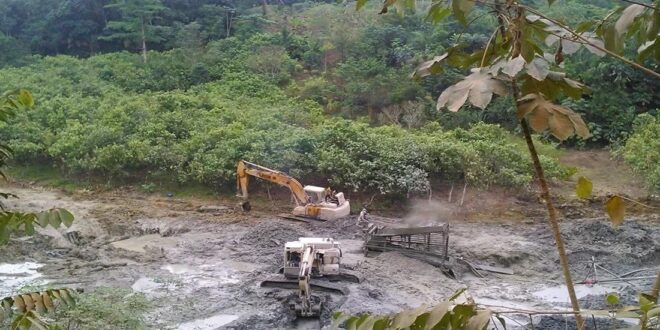
The shift, like “galamsey” intensified around 2008, following China’s “Go Out” policy, which encouraged its nationals to seek work overseas, including in Ghana. Researcher Nathaniel Ocquaye highlights that the influx of Chinese miners irreversibly transformed Ghana’s artisanal and small-scale mining sector, replacing hand tools with heavy machinery. This mechanisation—involving the use of bulldozers, excavators, and dredging equipment—allowed for the swift levelling of forests and the eradication of productive cocoa farms, a feat previously impossible for local miners. Furthermore, the techniques employed in this industrialised extraction process utilise heavy metals like mercury and chemicals such as cyanide to process the gold, contaminating vital national rivers and leading to serious public health issues, birth defects, and the decimation of fish populations, directly impacting the livelihoods of fishermen.
The environmental contamination has cascaded into a humanitarian crisis, particularly concerning the scarcity of clean water. In communities like Elmina, clean water access is severely limited, forcing residents, especially the elderly, to rely on expensive, filtered sachet water for basic necessities like washing food. This problem is widespread; a 2023 UNICEF report noted that nearly 22% of rural Ghanaians lack access to safe drinking water year-round. While a 2013 crackdown resulted in the deportation of over 4,500 Chinese nationals, their advanced technology was left behind, repurposed by locals, and subsequently fueled a sustained trade where Chinese entrepreneurs now export heavy machinery like the “changfa” dredging equipment to Ghanaian business partners.
This shadow economy is further supported by a deeply entrenched network of corruption. Illegal gold mining profits have enabled some foreign actors to establish legal businesses in Ghana, including construction firms, supermarkets, and casinos, which analysts say serve as fronts for gold smuggling and the recruitment of more foreign miners. The ease with which these foreign operations thrive is attributed by Ocquaye to the complicity of corrupt Ghanaian officials, who allegedly provide false immigration documents, and some local chiefs, who reportedly sell communal farmland to the miners. In response, the Ghanaian government has recently convened numerous consultation meetings and established new measures, including an inter-agency task force, the deployment of “Blue Water Guards” along rivers, and discussions about using drones and high-tech monitoring systems for surveillance. Ocquaye argues for a bilateral solution, suggesting Ghana should strictly regulate every Chinese business and promote a collaboration where China provides necessary financial resources and technical expertise to mitigate the crisis.